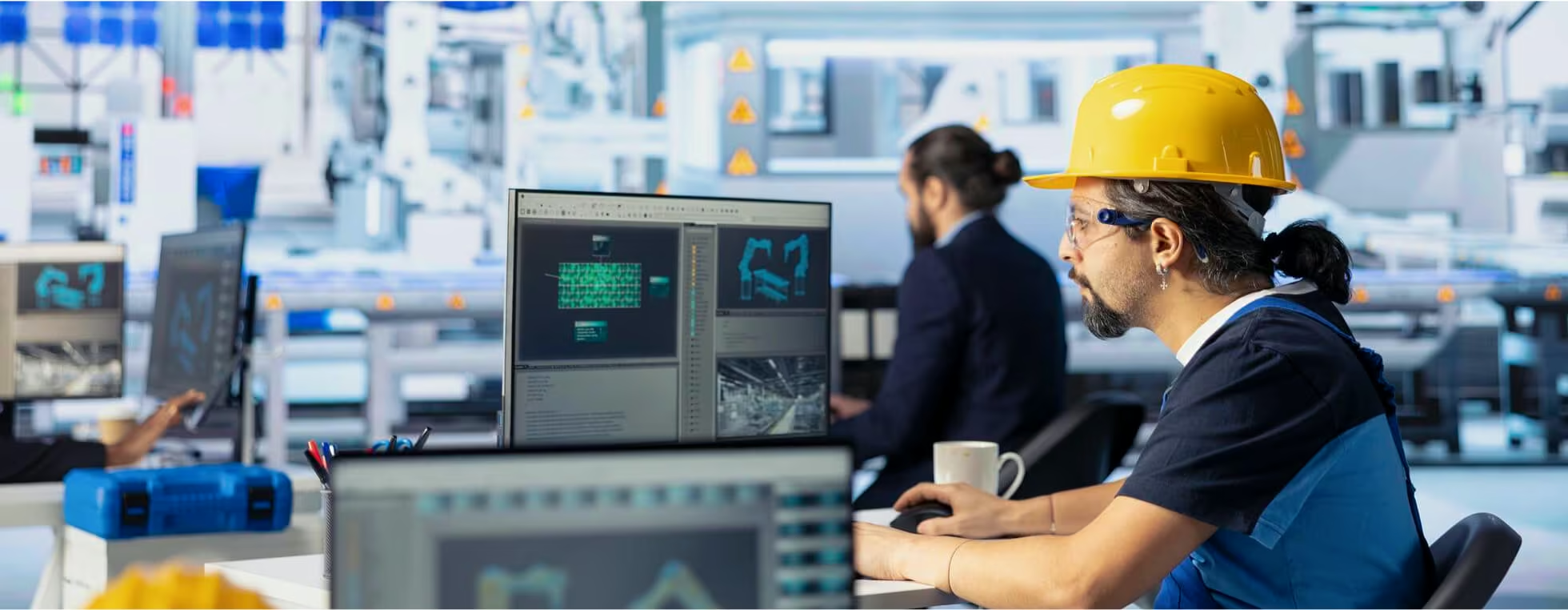
In discrete manufacturing, where distinct products like vehicles, electronics, or appliances are produced through precise assembly processes, indoor positioning technology revolutionizes operations. By delivering real-time location data, this technology enhances efficiency, asset management, safety, decision-making, and adaptability in factories and warehouses. Among various indoor positioning technologies, UWB (Ultra-Wideband) stands out for its centimeter-level accuracy, and Tsingoal, a pioneer in high-precision positioning solutions, has further amplified these advantages with its tailored UWB systems. Below are five key ways indoor positioning—powered by Tsingoal UWB—transforms discrete manufacturing.
1. Streamlining Operational Workflows
Indoor location tracking enables real-time tracking of tools, materials, and personnel, eliminating delays caused by misplaced resources. Tsingoal’s UWB solution takes this a step further: its compact, durable tags can be attached to everything from tiny precision components to large assembly tools, and its high-sensitivity sensors ensure seamless coverage even in complex factory environments with metal structures or heavy machinery. For instance, in an automotive assembly plant, workers can locate a critical engine part within 10 seconds using Tsingoal’s UWB-enabled dashboard, compared to the 30+ minutes typically required with manual searches—ensuring smooth production and minimizing downtime.
Automated inventory tracking further optimizes workflows by reducing manual errors. Tsingoal’s UWB system integrates seamlessly with warehouse management systems (WMS), automatically updating inventory counts as tagged materials move in and out of storage zones. Continuous monitoring of material levels prevents shortages; for example, a consumer electronics manufacturer using Tsingoal UWB reported a 40% reduction in production halts caused by missing components, maintaining uninterrupted production and boosting operational efficiency in competitive manufacturing environments.
2. Maximizing Equipment Efficiency with UWB Positioning
By tracking equipment usage and movement, indoor positioning systems provide insights into performance and maintenance needs. Tsingoal’s UWB positioning system excels here with its 10-30cm accuracy, which captures not just where a machine is, but how it’s being used—such as idle time, movement frequency, and vibration patterns. This granular data enables predictive maintenance: Tsingoal’s AI-integrated platform analyzes equipment movement and operational data to forecast potential failures, triggering maintenance alerts before breakdowns occur. A heavy machinery manufacturer implemented this solution and saw a 35% reduction in unexpected equipment downtime, extending machinery lifespans by an average of 18%.
Analyzing usage patterns also identifies underutilized assets. Tsingoal’s UWB dashboard generates heatmaps of equipment activity, highlighting machines that are rarely used. A aerospace parts factory used these insights to reallocate three underutilized CNC machines to high-demand production lines, cutting operational costs by 22% and improving return on investment. This ensures optimal equipment use, making manufacturing processes more efficient.
3. Enhancing Worker Safety via Real-Time Monitoring
Indoor positioning strengthens workplace safety by monitoring personnel in real time, and Tsingoal’s UWB solution prioritizes worker protection with specialized features. Its wearable UWB tags—designed as lightweight wristbands or integrated into safety helmets—include SOS buttons and automatic hazard alerts. If a worker enters a restricted zone (e.g., near a running press) or approaches moving machinery, the system triggers instant audio-visual alerts on both the worker’s tag and the supervisor’s dashboard, enabling quick action to prevent accidents. A metal fabrication plant reported a 50% drop in near-miss incidents within three months of deploying this feature.
In emergencies, precise location data ensures rapid response. Tsingoal’s UWB system pinpoints affected individuals with centimeter accuracy, even in large facilities. During a fire drill at an appliance factory, emergency teams located “trapped” workers 70% faster than with traditional emergency protocols, minimizing response times. This creates a safer work environment and reduces production disruptions caused by safety incidents.
4. Enabling Data-Driven Optimization
Indoor positioning systems generate detailed data on asset and personnel movements, revealing bottlenecks and inefficiencies. Tsingoal’s UWB indoor location platform processes this data in real time, providing actionable insights through customizable reports. For example, a electronics assembly plant used the platform to analyze worker and material flow, discovering that a poorly placed component storage area was adding 15 minutes to each assembly cycle. Relocating the storage zone based on Tsingoal’s data cut cycle times by 20%.
Integrating location data with systems like ERP (Enterprise Resource Planning) or MES (Manufacturing Execution System) provides a comprehensive operational overview. Tsingoal’s open, modular UWB system supports seamless integration with these enterprise systems, allowing manufacturers to correlate location data with production metrics (e.g., output, quality). A medical device manufacturer used this integrated approach to identify that a specific assembly station was causing 30% of production delays; refining the station’s layout and workflow boosted overall productivity by 17%.
5. Offering Flexible and Scalable Solutions
Indoor positioning systems are highly adaptable, tailored to the specific needs of each facility—and Tsingoal’s UWB solution is designed for maximum flexibility. Whether a factory requires sub-meter precision for intricate electronics assembly or zone-level tracking for warehouse storage, Tsingoal can adjust its UWB sensor density and tag configurations to match. For example, a small precision parts manufacturer uses a basic Tsingoal UWB setup for tool tracking, while a large automotive plant deploys a full-scale system with hundreds of sensors for end-to-end production monitoring.
As manufacturing needs evolve, the system scales seamlessly. Tsingoal’s UWB components are plug-and-play, allowing facilities to add new sensors or tags as they expand into new product lines or outdoor yards. A furniture manufacturer initially deployed Tsingoal UWB for warehouse tracking; when it expanded to include a new assembly wing six months later, the system was extended in just two days without disrupting existing operations. This flexibility ensures long-term value, adapting to future demands without requiring significant reinvestment.
Conclusion
Indoor positioning technology—especially when powered by high-precision UWB solutions—transforms discrete manufacturing by delivering unparalleled efficiency and safety. Tsingoal’s UWB tracking devices and systems, with their accuracy, durability, and seamless integration capabilities, are at the forefront of this transformation. By addressing core manufacturing pain points—from misplaced assets to unplanned downtime—Tsingoal enables manufacturers to innovate, reduce costs, and maintain sustained competitiveness in the industry. As discrete manufacturing continues to evolve toward smart production, Tsingoal’s UWB solutions will remain a critical enabler of the factories of the future.