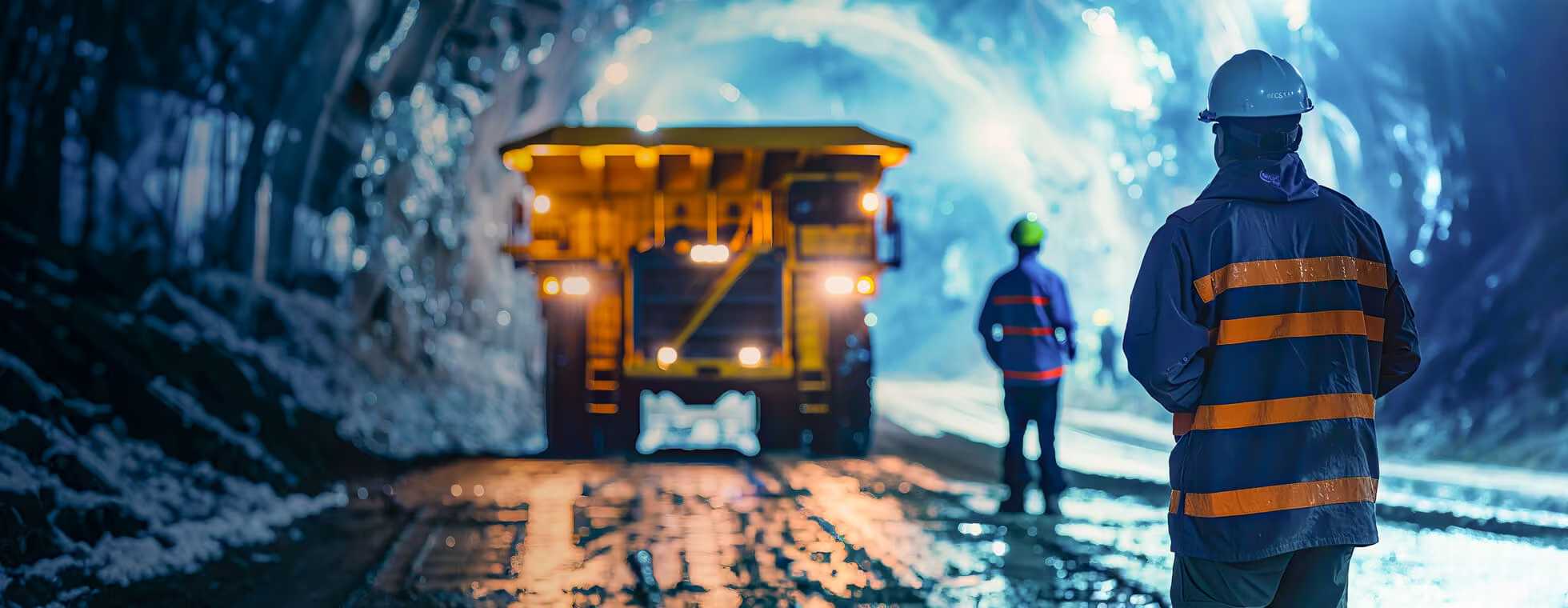
Underground environments like mines and tunnels pose formidable obstacles for indoor positioning technology, from signal-scattering rock formations to pervasive dust and humidity that degrade accuracy. Unlike surface-level industries such as warehousing or manufacturing—where open spaces allow for straightforward signal propagation—these subterranean realms demand systems resilient to multipath interference and blind spots. Tsingoal’s latest Real-Time Location System (RTLS) advancements, featuring upgraded hardware and AI-driven algorithms, deliver 0.1m (10cm) precision, setting a new benchmark for reliability in such harsh conditions. This evolution ensures uninterrupted tracking, empowering operators to prioritize safety and efficiency where margins for error are razor-thin.
Unique Demands of Underground Positioning
Positioning needs vary starkly across sectors. In smart buildings or data centers, centimeter accuracy suffices for asset mapping in controlled, low-interference settings. Warehouses might tolerate meter-level tracking for broad inventory flows. But mines and tunnels? Here, environmental factors like metallic reinforcements causing signal echoes or ventilation shafts disrupting propagation can inflate errors to meters, risking lives during evacuations or equipment mishaps.
Tsingoal addresses this with TsingSense, a centimeter-level ranging engine engineered for immunity to dynamics and interference. Recent hardware upgrades include ruggedized UWB tags with enhanced RF shielding, capable of withstanding vibrations and corrosive atmospheres. On the algorithm front, AI-powered modeling now incorporates machine learning to filter noise in real-time, achieving 0.1m accuracy even in echo-heavy tunnels— a leap from earlier iterations that struggled below 30cm in similar tests.
Revolutionizing Safety in High-Risk Depths
Safety underground isn’t negotiable; it’s survival. Tsingoal’s RTLS tracker tags, affixed to helmets or vehicles, provide blind-spot-free monitoring, integrating seamlessly with environmental sensors for airflow and temperature alerts. In emergencies like collapses, the system’s millisecond updates pinpoint trapped personnel within seconds, slashing rescue times compared to traditional methods reliant on manual headcounts.
Proactive prevention shines through geofenced zones: If a loader veers toward an unstable seam, haptic feedback on worker devices triggers immediate halts. This contrasts with transportation hubs, where positioning focuses on traffic flow rather than life-threatening geohazards. Case in point: A coal mine in Inner Mongolia deployed these upgrades, reducing incident rates by 35% via precise collision avoidance, a feat unattainable without the refined 0.1m granularity.
Optimizing Operations Amid Adversity
Efficiency gains are equally profound. Real-time tracking of equipment and crews optimizes routes through labyrinthine drifts, minimizing idle time—a common pitfall in surface logistics but amplified underground by navigation delays. TsingMax™ networking architecture scales to 10x the capacity for massive IoT arrays, supporting thousands of tags without latency spikes, even as tunnels extend kilometers.
Analytics from the open API platform reveal patterns, like overuse of certain ventilation paths, enabling data-driven reallocations. In petroleum sites or energy plants, similar tech aids perimeter security; here, it evolves to handle seismic vibrations, ensuring closed-loop behavior recognition for early warnings. Deployments confirm: Over 1.38 million tags worldwide generate 11.9 billion data points daily, with mine applications showing 25% uptime improvements post-upgrade.
Deployment Realities and Future Horizons
Implementing in extremes requires ATEX-certified hardware for explosive risks, with flexible indoor-outdoor handoffs at shaft entrances. Pilots in high-interference zones validate the 0.1m claim, often outperforming competitors by 50% in accuracy under duress. Challenges like battery drain in remote sections are mitigated by energy-harvesting designs.
As Tsingoal iterates—drawing from a decade of refinements—these systems herald a safer, smarter subsurface era. For mines and tunnels, where precision isn’t a luxury but a lifeline, this 0.1m RTLS fusion of hardware robustness and algorithmic smarts transforms peril into productivity.