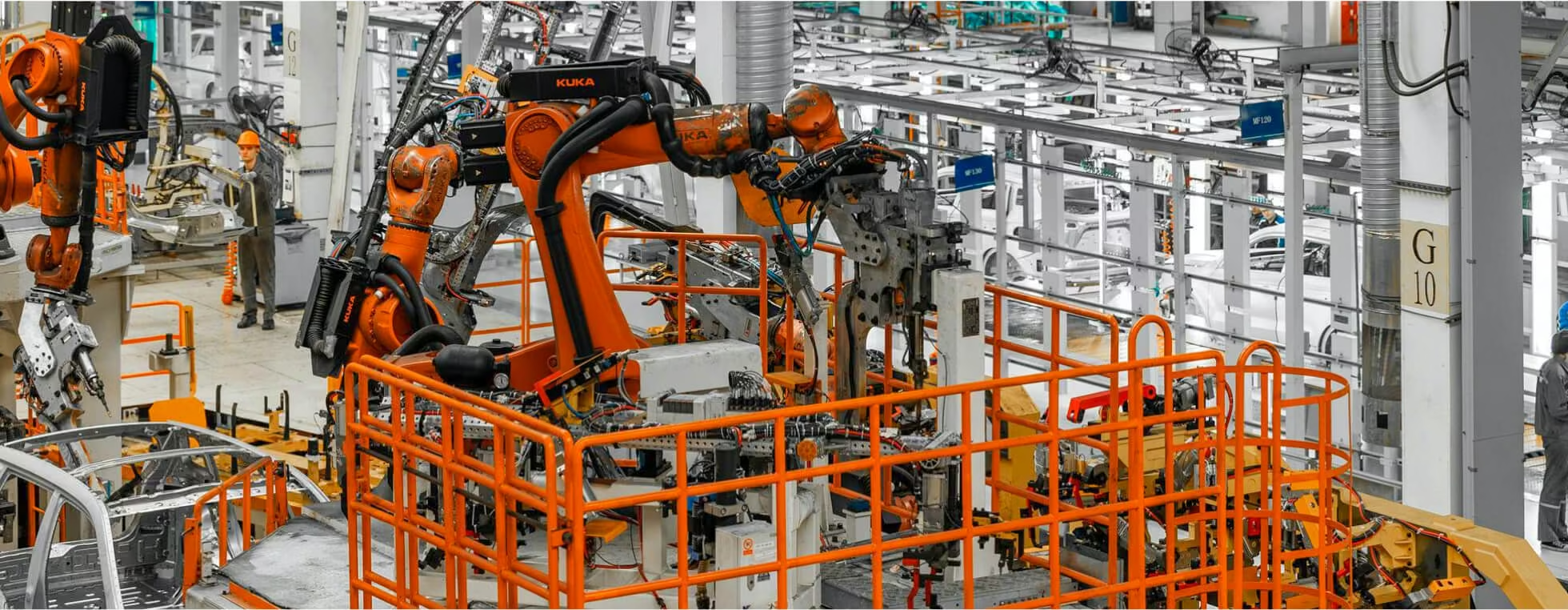
In the fast-paced world of discrete and process manufacturing, achieving peak efficiency is a constant challenge. With countless components, precision equipment, and production teams in motion across sprawling facilities, gaining a clear picture of shop-floor operations can feel like solving a moving puzzle. Real-time location systems (RTLS), often referred to as indoor positioning solutions, are transforming manufacturing plants by providing instant visibility into every aspect of the production process. Among these technologies, UWB (Ultra-Wideband) technology stands out as the core choice for high-end manufacturing tracking due to its centimeter-level positioning accuracy, and Tsingoal’s UWB solution further amplifies the value of real-time tracking with its high adaptability and practicality for industrial scenarios. These systems empower plant managers to eliminate bottlenecks, accelerate production cycles, and make data-driven decisions. Below, we explore how real-time tracking revolutionizes manufacturing operations and delivers measurable gains.
The Power of Real-Time Visibility and RTLS Technology
Manufacturing facilities are complex environments where delays in locating critical components or specialized equipment can ripple into costly production downtime. Traditional management systems, like Manufacturing Execution Systems (MES), often rely on static data or manual updates, which can lag behind the dynamic reality of assembly lines and machining processes. Real-time tracking bridges this gap by equipping assets—key components, CNC machines, robotic arms, or even production workers—with durable tags that broadcast their location to a network of industrial-grade sensors.
UWB technology, centered on nanosecond-level narrow pulse signal transmission, achieves positioning accuracy of 10-30 centimeters. It can precisely capture the real-time positions of both stationary production equipment and moving components, with strong anti-interference capabilities that remain unaffected by signal blockages from metal machining tools, heavy-duty conveyors, and dense component storage racks. Building on this foundation, Tsingoal’s UWB solution offers multiple optimizations tailored for manufacturing: its UWB tags come in various forms, including component-mounted, equipment-integrated, and personnel-worn (e.g., anti-collision wristbands, safety helmet modules), adapting to different tracking targets such as precision parts, automated guided vehicles (AGVs), and assembly technicians. Component-type tags are powered by ultra-low-consumption batteries with a maximum lifespan of 5 years, while equipment-integrated tags feature an IP68 waterproof and dustproof rating, capable of withstanding harsh manufacturing environments with coolant splatters, metal shavings, and extreme temperatures.
These systems deliver precise, up-to-the-minute data on the position and movement of every tagged item. By integrating this data with advanced analytics, manufacturing plants can monitor production performance, identify process inefficiencies, and implement targeted improvements. For example, tracking the time spent on each assembly step—from component delivery to machining completion—allows managers to pinpoint slow workflows and optimize production sequencing.
Streamlining Operations with Precision
Real-time tracking systems excel at providing a granular view of manufacturing activities. Imagine a scenario where a custom automotive parts manufacturer needs to locate a batch of high-precision engine components urgently for a critical production order, but their exact position among hundreds of storage bins is unknown. With Tsingoal’s UWB tracking tags and a centralized MES-integrated dashboard, workers can locate the components in seconds, slashing search times from hours to moments and keeping production on schedule. Tsingoal’s UWB solution further supports independent position data calculation and dual-channel parallel transmission, ensuring efficient and stable data transfer even in environments with high electromagnetic interference from welding equipment or industrial motors. Its multi-system compatible management platform can directly display the specific workstation location and movement trajectory of components, and even link with MES to automatically update production progress as parts move through each assembly stage.
Beyond finding items, these systems optimize broader production processes. By analyzing movement patterns of AGVs and personnel, managers can identify congested production zones or inefficient material delivery routes. For instance, a heavy machinery manufacturer used Tsingoal’s UWB technology to track AGV movement trajectories across its 50,000-square-meter plant, reconfiguring delivery routes to avoid cross-traffic with machining stations. This not only eliminated 80% of AGV congestion but also reduced component delivery waiting times for assembly lines by precisely locating the relative positions of AGVs and workstations, cutting average production cycle time by 18%. Such improvements not only boost productivity but also enhance order fulfillment speed, a critical competitive factor in manufacturing.
Integrating with Advanced Technologies
The true potential of indoor location tracking in manufacturing unfolds when paired with technologies like artificial intelligence (AI) and machine learning. These tools analyze location data to uncover hidden patterns, such as recurring bottlenecks at specific assembly stations or underutilized machining equipment. By feeding this data into an MES or Enterprise Resource Planning (ERP) system, managers gain a holistic view of operations, enabling smarter resource allocation and process refinement.
Tsingoal’s UWB solution demonstrates strong compatibility in this regard, supporting seamless integration with industrial IoT (IIoT) sensors, robotic control systems, and quality management software. It adapts to hybrid scenarios connecting indoor production lines and outdoor component yards without the need to deploy multiple redundant systems. For example, a large electronics manufacturer deployed Tsingoal’s UWB system to monitor 5,000 sets of precision circuit boards across its SMT (Surface Mount Technology) production line. Leveraging AI to analyze component movement frequency and dwell time at each soldering station, it optimized workflow sequencing to balance workloads. Meanwhile, combining UWB’s precise positioning enabled automatic docking between AGVs and robotic arms, reducing component loading times from 30 minutes to under 10 minutes and increasing daily output by 2,000 finished products. The investment in tracking technology paid for itself in just two and a half months, showcasing the rapid return on investment possible with these systems.Beyond finding items, these systems optimize broader production processes. By analyzing movement patterns of AGVs and personnel, managers can identify congested production zones or inefficient material delivery routes. For instance, a heavy machinery manufacturer used Tsingoal’s UWB technology to track AGV movement trajectories across its 50,000-square-meter plant, reconfiguring delivery routes to avoid cross-traffic with machining stations. This not only eliminated 80% of AGV congestion but also reduced component delivery waiting times for assembly lines by precisely locating the relative positions of AGVs and workstations, cutting average production cycle time by 18%. Such improvements not only boost productivity but also enhance order fulfillment speed, a critical competitive factor in manufacturing.
Overcoming Operational Challenges
RTLS asset tracking doesn’t just speed up processes—it helps solve persistent manufacturing challenges. Lost precision tools or misplaced high-value components can halt entire production lines, but tagged assets are always traceable, ensuring nothing slips through the cracks. Tsingoal’s UWB tags come with anti-tamper alarms and one-click SOS alerts tailored for industrial use: if a calibrated measuring tool is removed from its designated workstation without authorization, the system triggers an immediate alert. For high-value components like aerospace parts, geofencing can be set up, triggering an alert if the parts are moved out of the certified production zone, effectively preventing loss or misplacement risks. Its personnel-worn tags can also monitor workers’ real-time locations near hazardous equipment (e.g., stamping machines, chemical tanks), optimizing task assignments while safeguarding privacy to balance workloads and prevent operator burnout or idle time.
Workplace safety, a top priority in manufacturing, also benefits significantly. By monitoring equipment and personnel in real time, the system can issue proactive alerts for potential collisions or unsafe conditions. In one case, an automotive assembly plant reported a 32% drop in safety incidents after deploying Tsingoal UWB’s proximity alert function: when a worker approaches a moving AGV or an active robotic arm, both the worker’s wristband and the equipment’s control system trigger visual and audio alerts, using UWB’s precise ranging capability to warn of collision risks in advance.
Considerations for Implementation
While powerful, real-time tracking systems require careful planning to align with manufacturing workflows:
- Initial Setup Costs: Installing sensors and tagging thousands of components and equipment can be pricey. Tsingoal’s UWB solution simplifies deployment with a wire-free design—industrial beacons require no complex wiring, even in areas with heavy machinery, significantly reducing installation and maintenance costs. It also supports piloting in high-impact areas (e.g., critical assembly lines, precision component storage) before full roll-out, minimizing initial investment risks.
- Maintenance Needs: Tags rely on batteries, necessitating regular replacements. Tsingoal’s UWB tags adopt an ultra-low-power design optimized for manufacturing cycles, with some component-type models offering a battery life of over 3 years and equipment-integrated tags up to 5 years, greatly reducing battery replacement frequency and maintenance workload.
- Data Security: Connected systems must be secured with encryption and access controls to protect sensitive production data, such as process parameters and order information. Tsingoal’s UWB system transmits data in industrial-grade compliant frequency bands with end-to-end encrypted transmission processes. It also provides a modular open platform that can integrate with existing manufacturing security systems, building a solid data security barrier.
Conclusion
Real-time location systems (RTLS) are reshaping manufacturing operations by delivering unmatched visibility, efficiency, and agility. Among these technologies, UWB’s centimeter-level accuracy serves as the backbone of high-end manufacturing tracking, while Tsingoal’s UWB solution further unlocks the value of real-time tracking with its industrial-grade multi-form factor tags, long battery life, easy deployment, and high compatibility with manufacturing systems. From locating precision components in seconds to optimizing production workflows with AI-driven insights, these indoor location services empower manufacturing plants to overcome operational challenges and drive profitability. As global manufacturing demands grow more complex and competitive, adopting real-time tracking technology is a strategic move to stay ahead, ensuring every component, tool, and worker is exactly where they need to be to keep production efficient and reliable.
Inspired by innovations in location-based technologies for industrial transformation.